The Seven Species of the Promised Land, Explained
August 22, 20265 min readData
Moses describes the land Israel was about to enter with a single, specific list rather than vague praise: ‘A land of wheat, and barley, and vines, and fig trees, and pomegranates; a land of oil olive, and honey’ (Deuteronomy 8:8). Jewish tradition later named these seven crops the shivat ha-minim, the seven species, and used them as a marker of the land’s fertility long after the verse itself was written. This dataset’s own verse counts show why each one earned its place on Moses’ list, ranging from a modest 25 mentions up to nearly 200 across the whole of Scripture.
Wheat — 51 mentions
Wheat was the premium grain of the ancient world, reserved for festival loaves and wealthier households while barley fed everyone else. Jesus reached for a single kernel of it to describe his own death: ‘Except a corn of wheat fall into the ground and die, it abideth alone: but if it die, it bringeth forth much fruit’ (John 12:24). Its 51 mentions are modest next to some of the other six species, but the image it carries is one of the most quoted in the New Testament.
Barley — 35 mentions
Barley ripened weeks ahead of wheat and belonged to the poor — coarser, cheaper, and the first grain ready each year. It was barley loaves a boy handed over before Jesus fed five thousand people with them: ‘There is a lad here, which hath five barley loaves, and two small fishes: but what are they among so many?’ (John 6:9). At 35 mentions, it is among the least-cited of the seven, fittingly enough for the grain of the poor.
Vines — 192 mentions
Grapes and the vines that grew them appear far more often than any other species on this list — 192 verses, pressed into wine, dried into raisins, or eaten straight off the branch. The clearest picture of the land’s fertility comes from Moses’ own spies, who cut ‘one cluster of grapes’ so heavy that ‘they bare it between two upon a staff’ (Numbers 13:23), a single image that did more to advertise Canaan’s abundance than any description could.
Fig trees — 55 mentions
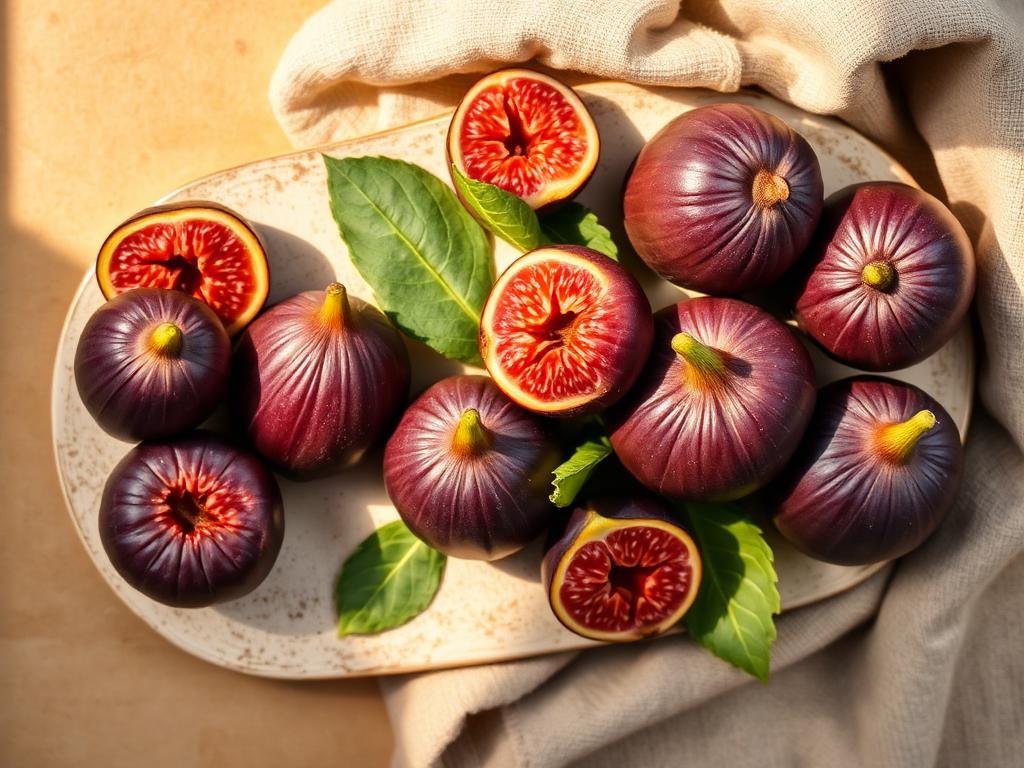
The fig tree is the first plant Scripture names by species, its leaves sewn into the first clothing in Genesis 3:7. Centuries later it became shorthand for peace and settled security: ‘every man under his vine and under his fig tree; and none shall make them afraid’ (Micah 4:4) — a peacetime image repeated almost word for word in two other books (1 Kings 4:25; Zechariah 3:10).
Pomegranates — 25 mentions
Pomegranates grew well enough in Canaan to count among its defining crops, prized for tart, ruby seeds and a crown-shaped blossom striking enough to decorate sacred spaces long after the fruit itself was gone — embroidered along the hem of the high priest’s robe (Exodus 28:34) and cast in bronze, two hundred at a time, around the temple’s great pillars (1 Kings 7:20). At 25 mentions, it is the least common of the seven species in the text, but among the most visually memorable.
Olive oil — 187 mentions
Olive oil is the second-most-mentioned species on this list at 187 verses, doing the work of fuel, food, and ceremony all at once — lighting lamps, cooking meals, and anointing kings and priests. Elijah once told a starving widow that her last small jar of it would not run dry ‘until the day that the LORD sendeth rain upon the earth’ (1 Kings 17:14), and through the length of a famine, it did not.
Honey — 61 mentions, and probably not from bees
The ‘honey’ closing out Deuteronomy 8:8 is widely understood by scholars to mean thick date syrup rather than honey from bees — the date palm was a far more reliable, more abundant sweetener in this agricultural context than wild honeycomb, and a single tree could bear fruit for decades. That reading matters for a common mix-up worth clearing up directly: the famous phrase ‘a land flowing with milk and honey’ is not this verse. Deuteronomy 8:8 never mentions milk at all, and the flowing-with-milk-and-honey phrase belongs to a different set of passages entirely, starting with Exodus 3:8. Honey itself is mentioned 61 times across Scripture, counting both senses of the word.
Seven crops, one snapshot
Seven species, one verse, and a set of verse counts that range from a modest 25 mentions to nearly 200 — together they were Moses’ shorthand for a land worth crossing a wilderness to reach. For a printable list of these and every other food this site tracks, download the free Starter Guide.
The Biblical Diet Starter Guide — free
The printable clean & unclean list, a week of shopping lists, and seven biblical recipes.
Weekly recipes & shopping lists follow. Unsubscribe anytime.